Kolokas in Cyprus: An Old Island Story from Beneath the Soil
Key takeaways
- Kolokas is the edible, starchy root of Colocasia esculenta.
- Mappa names the main rootstock; poulles are the smaller lateral roots.
- Kolokasi Sotiras / Kolokasi-Poulles Sotiras has held EU PDO status since 2016.
Kolokas does not arrive at the table in a hurry. It sits with tomato, meat or wine until the pot has made room for it, bringing with it more than a starchy root vegetable. It brings the long conversation between Cyprus soil, the growing season and the home kitchen. Calling it simply “taro” is accurate, but it leaves much of the island story untold.
What is Cyprus kolokas?
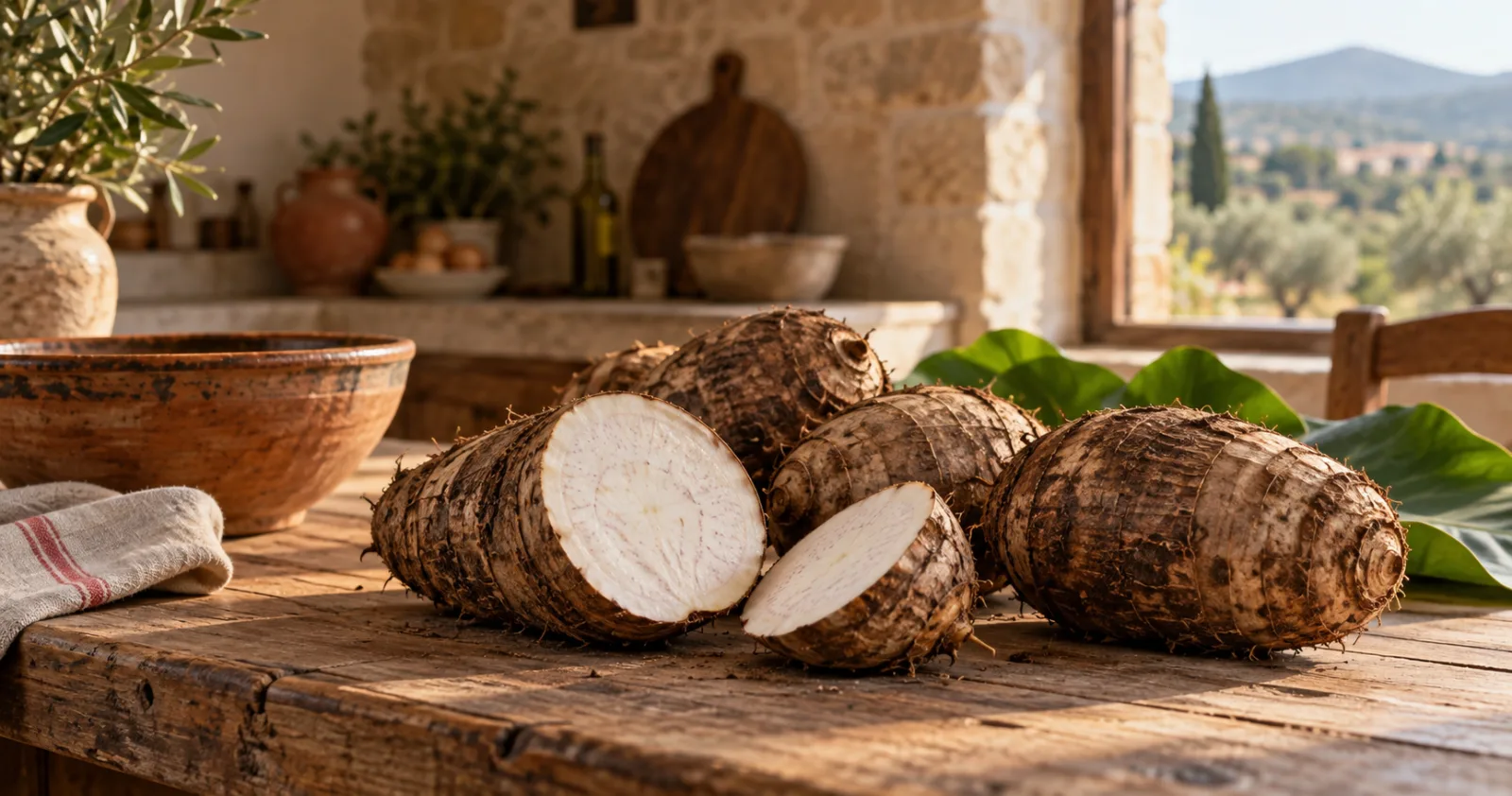
Kolokas is the edible, starchy root of Colocasia esculenta. The Cyprus Food Museum describes its cooked taste as close to potato, with a nuttier note. On the island, the large central rootstock is known as mappa; the smaller lateral roots are called poulles. They come from the same plant, yet the distinction matters in the field and in the kitchen: one is the main rootstock, the other its smaller offshoots.
That language keeps kolokas close to the ground. Here, the name of the food, the work of growing it and the way it is cooked belong to the same sentence.
A protected name from Sotira
Kolokasi Sotiras and Kolokasi-Poulles Sotiras entered the European Union register of Protected Designations of Origin in 2016. The registration does not suggest that all kolokas is identical. It protects the geographical link and the name of the product associated with Sotira. Official and museum sources place much of today’s cultivation in Famagusta district, especially in Sotira, with production also recorded in Avgorou, Frenaros and Liopetri, and on a smaller scale around Paphos.
That is why kolokas does not feel like an imported curiosity in a Cypriot kitchen. It is spoken of alongside red soil, growers and place names. Behind the brown root one might pass over in a market is the labour of a specific landscape.
An old trace at the table
The Cyprus Food Museum records the earliest written reference to kolokas on the island as dating to 1191. Citing Jeffery’s account, it notes that kolokas was served at the wedding feast of Richard the Lionheart and Berengaria at Limassol Castle. A single historical reference cannot turn a modern family pot into a medieval one. It does, however, show that kolokas has been part of the island’s food memory for a very long time.
The sources gathered by the museum also recall kolokas being eaten with koupepia or beans in the past. That small detail matters. Kolokas is remembered not only as an occasion dish, but as an ingredient of everyday meals.
When it reaches the pot
In Cyprus, kolokas may be cooked with tomato, with or without meat. The wine-based kappamas method is especially associated with Famagusta district. In the Food Museum’s recipe archive, one kappamas version combines lamb and kolokas, marinated in wine before cooking. Fried slices, chips and mash also have a place among mezé dishes.
There is no single correct kolokas recipe. One kitchen may lean into the acidity of tomato, another towards meat; another may bring small poulles to the table with lemon juice and dried coriander. The shared point is that kolokas is not treated as a neutral side dish. It can hold the centre of the meal.
How a growing calendar becomes a food story
The patience kolokas asks of the cook begins in the field. In records compiled by the Cyprus Food Museum, planting starts towards the end of February and continues through spring. In red soil, the plant develops the large main rootstock and the smaller lateral roots. Mappa and poulles are not a decorative culinary distinction; they name a difference that begins underground.
What makes a food local is not only what enters the pot. It is also when it is planted, the ground it grows in, the names given to its parts and the route it takes to market. Kolokas keeps all of those things in view.
One place name, not one single story
The PDO link with Sotira does not close the Cypriot story of kolokas around one location. The Cyprus Food Museum also records nineteenth-century references to production around Lapithos and Paphos, as well as extensive cultivation in some Karpasia and Mesaoria settlements in more recent history. The point is not to flatten those places into one account, but to remember that the island’s food memory has more than one voice.
Keeping kolokas in its proper place
The value of kolokas is not in turning it into a picturesque relic. It lies in naming its place of production, its protected designation and the variety of ways it is cooked with care. In the phrase “Cyprus kolokas”, Sotira’s protected name, the difference between mappa and poulles, and the cooking traditions of Famagusta can all meet.
At Gabira, we tell these stories not as a footnote to a recipe, but as part of what lets a recipe be understood. Some foods begin their story before a spoon ever touches the plate.
Sources
Frequently asked questions
What is kolokas?
Kolokas is the starchy, edible root of Colocasia esculenta. In Cyprus, mappa names the main rootstock and poulles the smaller lateral roots.
Why is Kolokasi Sotiras important?
Kolokasi Sotiras and Kolokasi-Poulles Sotiras have been registered as EU Protected Designations of Origin since 2016, recognising the product’s geographical link with Sotira.
How is kolokas cooked in Cyprus?
Kolokas can be cooked with tomato, with or without meat. Wine-based kappamas is associated with Famagusta district; fried slices, chips and mash are also used.